
Manual Software Testing Course
Quality assurance starts with a solid grasp of manual software testing fundamentals before moving into advanced technical workflows. In today's software-driven world, applications need careful verification to run smoothly and provide a great user experience. This manual software testing course is built for anyone looking to learn QA from the ground up through practical, hands-on training that matches what hiring teams look for. Whether you are starting fresh or looking to switch careers into tech, this program guides you step by step. You will learn how to write clear test cases, perform exploratory checks, and log bugs using tools like Jira. To keep building your skills, you can also check out our foundational QA Software Testing - 101 program or look into Automation Testing when you are ready to code. Step into the tech industry with confidence and build a strong foundation in software quality.
Not sure? Get Free Consultation Today!
Course Includes
- Software testing in the SDLC
- Manual vs. automated testing
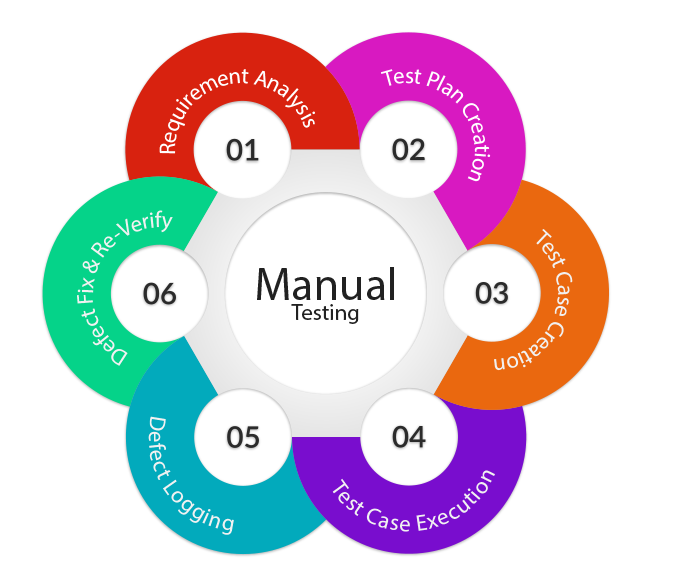
- Software testing process
- Importance of quality assurance
- Principles of testing
- The psychology of testing
- Testing process and test levels
- Significance of test planning
- Developing a test plan
- Creating test cases and test scripts
- Traceability matrix
- Test case design techniques (Boundary Value Analysis, Equivalence Partitioning, etc.)
- Manual test case execution
- Defect identification and reporting
- Regression testing and retesting
- Defect lifecycle management
- Severity and priority of defects
- Introduction to test management tools (e.g., TestRail, Zephyr, HP ALM)
- Test case management, execution, and reporting with test management tools
- Functional testing
- Non-functional testing (performance, security, usability)
- Compatibility testing
- Exploratory testing
- Usability testing
- User acceptance testing (UAT)
- Smoke testing and sanity testing
- Test reporting and documentation
- Metrics in software testing
- Test summary and test closure report
- Setting up test environments
- Data management for testing
- Agile methodologies and testing
- Role of a tester in agile projects
- Continuous testing in agile
- Benefits of test case reviews
- Conducting effective test case reviews
- API with Postman
- Real life project
Session Start |
|---|
| March 16, 2024 |
Related Courses


Frequently Asked Questions
A manual testing course teaches you how to evaluate software features by hand without writing automated scripts. You learn the core principles of the Software Development Life Cycle (SDLC) and Software Testing Life Cycle (STLC), along with how to design test scenarios, execute test runs, and log defects properly. Students also gain experience using popular bug-tracking software like Jira to collaborate with development teams. To complement your testing skills, it is often helpful to explore basic backend data management through an introductory SQL module.
No prior programming or computer science background is necessary to start learning manual quality assurance. This makes it one of the most accessible entry points for people switching careers into the technology sector. The focus is entirely on analytical thinking, attention to detail, and evaluating software from an end-user perspective. While coding isn't required at this stage, many learners eventually move on to technical tracks like AI-Powered Software Automation Testing once they understand how software behaves.
The duration depends on your preferred learning pace, typically taking a few weeks to a couple of months to complete. The curriculum blends short lessons with practical labs so you can apply what you learn immediately. After wrapping up the core modules, students spend time building portfolios and practicing interview questions. Because companies continuously release updates and new digital products, demand for qualified QA professionals remains consistently steady.
Graduates typically apply for entry-level roles such as Junior QA Analyst, Manual Tester, or Quality Control Specialist. Gaining hands-on experience evaluating web applications gives you a strong footing in the software industry. From there, many testers choose to specialize further by exploring fields like Mobile Testing or Performance Testing to expand their technical skill sets and career options.
This training program is designed to give you practical, job-ready experience rather than just heavy theory. You work with the exact tools and workflows used by real development teams daily, helping you transition smoothly into the workplace. With clear mentorship and a structured path that connects to advanced areas like Automation Testing, you get a reliable roadmap to build a long-term career in tech.
